Student Researcher University of Lynchburg Lynchburg, Virginia, United States
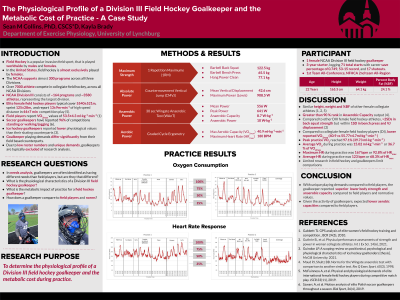
Purpose: This study aimed to examine the physiological demands and performance profile of a Division III field hockey goalkeeper. Methods: A Division III field hockey goalkeeper (22 yo, 165.3cm, 64.1kg, and 24.1%BF) went through several baseline tests including anthropometrics assessing height, weight, and body composition via air density plethysmography (BodPod, Cosmed). Muscular strength was assessed using one repetition maximum (1RM) bilateral back squat and barbell bench press to determine upper and lower body muscular strength. Strength-power assessment was determined by the 1RM hang power clean and absolute power was determined using the Lewis Power Equation from the counter movement vertical jump (CMVJ; JustJump Mat). Anaerobic power was assessed via the 30-second Wingate (WAnT) test and aerobic power was determined by a graded exercise cycle ergometry maximal test (VO2max) using a portable metabolic cart (K5, Cosmed). Following physiological assessment, the subject participated in on-field monitoring of heart rate (H10, Polar) and oxygen consumption via a portable metabolic cart (K5, Cosmed) during two 2-hr off-season training sessions. Results: The participant reported 1RMs of 122.5kg, 65.5 kg, and 77.1 kg for the bilateral back squat, bench press, and hang power clean, respectively. They reported an average power, via the Lewis Equation, of 908.5W from a CMVJ of 42.6cm. From the WAnT, the participant reported a mean power of 556W, a peak power of 641W, with a time to peak power of 10.1sec. Maximum anaerobic capacity and anaerobic power were determined to be 8.7W·kg-1 and 10.0W·kg-1, respectively. Aerobic capacity was determined to be 40.9 ml·kg-1·min-1 with a HRmax of 180bpm. During practice activities, average VO2 was reported to be 15.02 ml·kg-1·min-1 and an average peak of 37.37ml·kg-1·min-1, with an average HR of 123bpm and an average peak HR of 167bpm. Conclusions: Strength values put the participant in the 90th percentile ranks of female Division I college athletes and greater than 1SD of the reported means for CMVJ height of national-level women soccer and lacrosse athletes. Compared to normative values, the participant reports in the 70th percentile for maximum aerobic capacity for her age group. Practice intensity was determined to be 36.7% of VO2max, with a peak reporting of 91.35% of VO2max with an average heart rate of 64% of HRmax. Practical Applications: Goalkeepers are an underrepresented group in research due to low numbers on teams and equipment and movement restraints of the position. Understanding their unique profile, skills, and demands can help develop specific training programs. Field hockey goalkeepers experience high levels of strength, power, anaerobic capacity, and aerobic demands during practices and require training to address these demands in preparation for the sport. Acknowledgements: None