Assistant Professor Texas A&M University-Corpus Christi Corpus Christi, Texas, United States
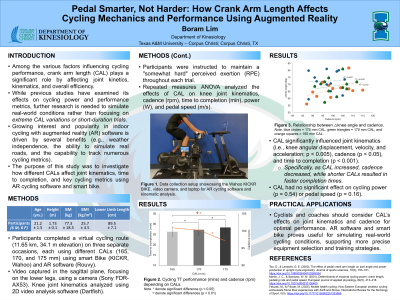
Purpose: Among the various factors influencing cycling performance, CAL plays a significant role by affecting joint kinetics, kinematics, and overall efficiency. The selection of crank arm length (CAL) is typically based on leg length, personal preference, and race strategy. While previous studies have examined its effects on cycling power and performance metrics, further research is needed to simulate real-world conditions rather than focusing on extreme CAL variations or short-duration trials. Therefore, the purpose of this study was to investigate how different CALs affect joint kinematics, time to completion, and key cycling metrics. Methods: Twelve recreationally trained cyclists (6 males, 6 females; age: 21.2 ± 1.5 yrs., height: 1.73 ± 0.12 m, body mass: 77.3 ± 18.5 kg, BMI: 25.7 ± 4.5 kg/m²) completed a virtual cycling route (11.65 km, 34.1 m elevation) on three separate occasions, each using a different CAL (165 mm, 170 mm, 175 mm). Prior to data collection, a video camera (FDR-AX53, Sony, Tokyo, Japan) was set up in the sagittal plane, specifically focusing on the lower legs, to analyze knee joint kinematics using 2D video analysis software (Dartfish, Fribourg, CH). Subjects were instructed to maintain a “somewhat hard” intensity while cycling on a a smart bike (KICKR BIKE, Wahoo, Atlanta, GA) with augmented reality software (Rouvy, Vimperk, CZ). Repeated measures ANOVA analyzed the effects of CAL on knee joint kinematics, cadence (rpm), time to completion (min), power (W), and pedal speed (m/s). Results: CAL significantly influenced knee joint kinematics (i.e., angle displacement, velocity, and acceleration; p < 0.005), cadence (p < 0.05), and time to completion (p < 0.001). Specifically, as CAL increased, cadence decreased, while shorter CALs resulted in faster completion times. However, CAL had no significant effect on cycling power (p = 0.54) or pedal speed (p = 0.16). Conclusions: CAL significantly affects knee joint kinematics, cadence, and time to completion but does not influence cycling power or pedal speed. These findings suggest that CAL impacts movement mechanics and efficiency without altering overall power output. Practical Applications: Cyclists and coaches should consider CAL’s effects on joint kinematics and cadence for optimal performance. Augmented reality proves useful for simulating real-world cycling conditions, supporting more precise equipment selection and training strategies. Acknowledgements: None