Student Concordia University Green Bay, Wisconsin, United States
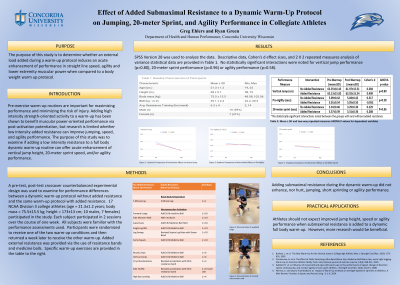
Purpose: Pre-exercise warm-up routines are important for maximizing performance and minimizing the risk of injury. Adding high intensity strength-oriented activity to a warm-up has been shown to benefit muscular power-oriented performance via post-activation potentiation, but research is limited whether low intensity added resistance can improve jumping, speed, and agility performance. The purpose of this study was to examine if adding a low intensity resistance to a full body dynamic warm-up routine can offer acute enhancement of vertical jump height, 20-meter sprint speed, and/or agility performance. Methods: A pre-test, post-test crossover counterbalanced experimental design was used to examine for performance differences between a dynamic warm-up protocol without added resistance and the same warm-up protocol with added resistance. 17 NCAA Division 3 college athletes (age = 21.3±1.2 years; body mass = 75.5±15.5 kg; height = 173±13 cm; 10 males, 7 females) participated in the study. Each subject participated in 2 sessions over the course of one week. All subjects were familiar with the performance assessments used. Participants were randomized to receive one of the two warm-up conditions and then returned a week later to receive the other warm-up. Added external resistance was provided via the use of resistance bands and medicine balls. Warm-up exercises included: 5-minute jog, forward lunge (1 set of 10 reps; added resistance = 10 lb. medicine ball), side monster walk (1 set of 10 reps; added resistance = red band), superman (1 set of 10 reps; added resistance = 6 lb. medicine ball), single leg dead lift (1 set of 10 reps; added resistance = 10 lb. medicine ball), leg swings (1 set of 10 reps; no added resistance), sumo squats (1 set of 10 reps; added resistance = 10 lb. medicine ball), broad jumps (1 set of 6 reps; added resistance = 10 lb. medicine ball), vertical jumps (1 set of 6 reps; added resistance = 10 lb. medicine ball), 10-yard accelerations (1 set of 3 reps; added resistance = 50 lb. resistance band), side shuffle (2 set of 10 reps; added resistance = 50 lb. resistance band), and high box landing (1 set of 4 reps; added resistance = 10 lb. medicine ball). Results: SPSS Version 28 was used to analyze the data. Descriptive data, Cohen’s d effect sizes, and 2 X 2 repeated measures analysis of variance statistical data are provided in Table 1. No statistically significant interactions were noted for vertical jump performance (p=0.80), 20-meter sprint performance (p=0.96) or agility performance (p=0.58). Conclusions: Adding submaximal resistance during the dynamic warm-up did not enhance, nor hurt, jumping, short sprinting or agility performance. Practical Applications: Athletes should not expect improved jump height, speed or agility performance when submaximal resistance is added to a dynamic full body warm-up. However, more research would be beneficial. Acknowledgements: None