Associate professor Winona State University Winona, Minnesota, United States
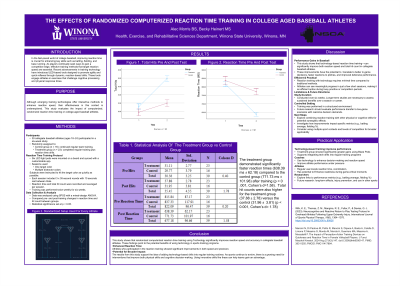
Purpose: Reaction time is crucial for batting, fielding, and base running in collegiate baseball. Although emerging training technologies offer interactive methods to enhance reaction speed, their effectiveness in this context is underexplored. This study evaluates the impact of computerized, randomized reaction time training on college-aged baseball athletes. Methods: Thirty-nine athletes ages 18–24 from a local collegiate baseball team participated in a six-week training study. Participants were assigned to either a control group n=16, which continued regular training, or a treatment group n=23 that performed their regular training plus specialized reaction time drills. The set-up for the reaction training involved mounting six pods with led lights to a board. The pods were synced with a customizable application and target color, distraction colors, and exercise dosage were selected. For each trial, subjects were instructed to hit the target color as quickly as possible amongst the distractor colors. Each session included 3 rounds of 30 seconds with a 10 second rest between trials. Reaction times and total hit counts were recorded and averaged per session. Training sessions occurred twice weekly. Data was analyzed using SPSS mixed design ANOVA to determine changes in reaction time and hit count after training. Differences in reaction time of the training group were compared to the control with a statistical significance value of p < 0.05 for all analyses. Results: The treatment group demonstrated significantly faster reaction times (638.39 ms ± 62.18) compared to the control group (771.73 ms ± 101.98) after training (p < 0 .001, Cohen’s d=1.58). Total hit counts were also higher for the treatment group (37.88 ± 2.78) versus the control (31.96 ± 3.81) (p < 0.001, Cohen’s d= 1.78) Conclusions: Computerized reaction time training appears to be an effective training strategy to enhance reaction time in collegiate baseball players. Practical Applications: Sport and performance coaches should consider using computerized reaction time training as part of their regimen if they are seeking to improve the reaction time of their athletes. Acknowledgements: None

.jpeg.jpg "Alec J. Morris photo")