Assistant Professor Southern Utah University Cedar city, Utah, United States
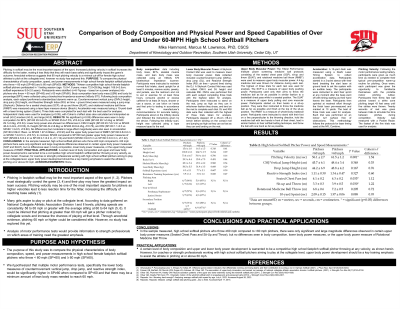
Purpose: To compare the physical characteristics of body composition, speed, and power measurements in high school female fastpitch softball pitchers who throw < 60 mph (SP< 60) and ≥ 60 mph (SP≥60). Methods: Thirteen competitive high school female fastpitch softball pitchers participated in 1 testing session (age: 15.9±1.8 years; mass: 72.0±29.8kg; height: 166.5±2.5cm; softball experience 8.0±2.0 years). Participants were stratified (n=6-7/group – based on a power analyses) into pitchers who throw < 60 mph (SP< 60) and ≥ 60 mph (SP≥60). Body composition lean body mass (LBM) and body fat percentage (BF%) were collected using a bioelectrical impedance scanner (InBody 570). Following body composition analysis, each subject performed a standardized dynamic warm-up. Countermovement vertical jump (CMVJ) height, drop jump (DJ) height, and Reactive Strength Index (RSI; air time ÷ ground time) were measured using a jump map (Skyhook). Distance for a seated chest pass (SCP), sit-up and throw (SUAT), and rotational medicine ball throw (RMBT) was measured using a laser tape measure device (Bosch). Acceleration was measured using a 10-yard dash with a laser timing system (Dashr). Three trials were completed for each test with the best used for analyses. Independent t-tests were used for analyses (p< 0.05), with Cohen’s d effect sizes also calculated and interpreted as small (≥0.2) medium (≥0.5), and large (≥0.8). Results: No significant (p >0.05) differences were seen in body composition for BF% (SP< 60 29.3±8.4% vs SP≥60 25.6±7.5%; d=0.44) or LBM (SP< 60 28.1±3.4kg vs SP≥60 29.1±2.2kg, d=0.34). Lower body power also showed no differences in CMVJ height (SP< 60 45.7±6.1cm vs SP≥60 48.4±3.4cm, d=0.53), DJ height (SP< 60 44.2±6.9kg vs SP≥60 48.8±4.2kg, d=0.76), and RSI (SP< 60 1.1±0.3 vs SP≥60 1.3±0.5, d=0.60). No differences (but moderate to large effect magnitude) were also seen in acceleration (SP< 60 2.09±0.15sec. vs SP≥60 1.97±0.06sec., d=0.93) and the upper body power test of RMBT (SP< 60 6.8±0.6 m vs SP≥60 7.2±0.5 m, d=0.72). In contrast, SP≥60 compared to SP< 60 had greater upper body power measures of SCP (SP≥60 4.3±0.2 m vs SP< 60 4.1±0.2 m, d=1.12) and SUAT (SP≥60 3.9±0.5 m vs SP< 60 3.3±0.3 m, d=1.22). Conclusions: In the sample measured, high school softball pitchers who throw ≥60 mph compared < 60 mph pitchers there were only significant and large magnitude differences observed in certain upper body power measures (SCP and SUAT), but no differences seen in body composition, lower body power measures, or the upper body power measure of RMBT. Practical Applications: A certain level of body composition and upper and lower body power development is warranted to be a competitive high school fastpitch softball pitcher throwing at any velocity, as shown herein. However, for coaches or strength professionals working with high school softball pitchers aiming to play at the collegiate level, upper body power development should be a key training emphasis to assist the athlete in pitching at or above 60 mph. Acknowledgements: None.