Graduate Research Assistant Kennesaw State University Kennesaw, Georgia, United States
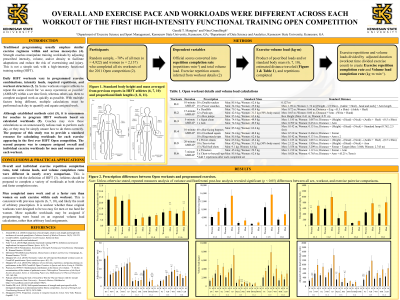
Purpose: The six workouts programmed for the first high-intensity functional training (HIFT) open competition were all uniquely designed and meant to comprehensively test a range of fitness and skill parameters. Different exercises and associated prescription presumably would affect work requirements and pacing, but neither the workouts nor their individual prescription for men and women have ever been compared. This study aimed to quantify and compare overall and individual exercise workloads assigned to men and women for the six workouts of the first HIFT open competition. Methods: Official scores from a random sample equating to ~70% of all men and women who completed all six workouts of the 2011 open competition were converted into repetition completion rates (repetitions·min-1) and decomposed into repetition counts for each exercise. Repetition counts, prescribed loads (when applicable), and a standard model (man: 85.6 kg; 177.2 cm; woman: 62.6 kg; 163.6 cm) with proportional limb lengths were used to estimate force expression on each exercise and calculate workload (kg·m). Exercise workloads were summed to quantify total workload and divided by workout duration to quantify workload completion rate (kg·m·min-1). Repetition and workload completion rates for individual exercises were adjusted for the number of exercises assigned to a specific workout. Results: Two-way (sex x workout or sex x exercise) analyses of variance with repeated measures revealed significant interactions (p < 0.001) for workout and exercise repetition completion rates, workloads, and workload completion rates. Men completed repetitions at a faster rate (1.07 – 2.59 repetitions·min-1, p < 0.001), a greater workload (639 – 6,303 kg·m, p < 0.001), and completed workloads faster (64 – 406 kg·m·min-1) than women on each workout, as well as on each exercise (p < 0.001). Overall performance was different between each workout (p < 0.001) except for repetition completion rates of workouts five (12.8 ± 2.6 repetitions·min-1) and six (12.8 ± 3.1 repetitions·min-1) in men (p = 0.961), and workload completion rate of workouts one (418 ± 113 kg·m·min-1) and six (416 ± 140 k·gm·min-1) in women (p > 0.999). Significant mean differences (MD; p < 0.001) were also seen between all paired exercise comparisons except repetition completion rates of squat cleans, jerks, and overhead squats (workouts 3 and 4, MD = 0.09 ± 0.04 repetitions·min-1, p > 0.999) in men. In women, similar repetition completion rates were noted between deadlifts and wall ball shots (workouts 2 and 5, MD = 0.21 ± 0.06 repetitions·min-1, p = 0.051) and between toes-to-bar and thrusters (workouts 5 and 6, MD = 0.07 ± 0.05 repetitions·min-1, p > 0.999). Women also completed a similar workload with jerks and bar-facing burpees (workouts 3 and 4, MD = 13 ± 8 kg·m, p > 0.999) and a similar workload completion rate with squat cleans and jerks (workout 3, MD = 8 ± 5 kg·m·min-1, p > 0.999). Conclusions: Men completed more work and at a faster rate than women on each exercise within each workout. With some exceptions, repetition completion rate, workload, and workload completion rate were different within and across each workout. Practical Applications: These data demonstrate unique pace and workload requirements on each workout of the first HIFT open. Determining is true in future competitions would assist athletes and coaches in assessing and preparing for the needs of HIFT competition. Acknowledgements: None