Assistant Professor Southern Utah University Cedar city, Utah, United States
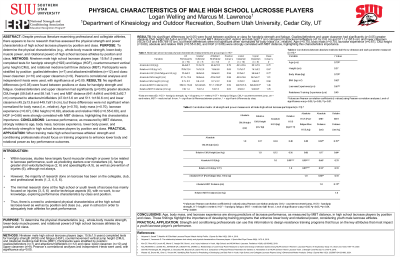
Purpose: To determine the physical characteristics (e.g., whole-body muscle strength, lower-body muscle power, and rotational power) of high school lacrosse athletes by position and class. Methods: Nineteen male high school lacrosse players (age: 15.9±1.5 years) completed tests for handgrip strength (HGS) and fatigue (HGF), countermovement vertical jump height (CMJ), and rotational medicine ball throw distance (MBT). Participants were stratified by position: goalies/defenders (n=7) and attackers/midfielders (n=12) and class: lower classmen (n=10) and upper classmen (n=9). Pearson’s correlational analyses and independent t-tests were used, with significance at p < 0.05. Results: No significant differences (p>0.05) were found between positions or class for handgrip strength and fatigue. Goalies/defenders and upper classmen had significantly (p< 0.05) greater absolute CMJ height (59.5±6.4 and 58.1±8.1 cm) and MBT distance (641.4±94.6 and 646.3±92.7 cm) compared to attackers/midfielders (47.0±13.6 cm and 511.1±130.6 cm) and lower classmen (45.2±13.8 and 449.7±91.6 cm), but these differences were not significant when normalized for body mass (i.e., relative). Age (r=0.70), body mass (r=0.70), lacrosse experience (r=0.67), CMJ height (r=0.69), absolute and relative HGS (r=0.55-0.60), and HGF (r=0.66) were strongly correlated with MBT distance, highlighting this characteristics importance. Conclusions: Lacrosse performance, as measured by MBT distance, strongly relates to age, body mass, lacrosse experience, lower body power, and whole-body strength in high school lacrosse players by position and class. Practical Applications: When training male high school lacrosse athletes’ strength and conditioning professionals should focus on training programs to enhance lower body and rotational power as key performance outcomes. Acknowledgements: None