Assistant Professor Texas State University San Marcos, Texas, United States
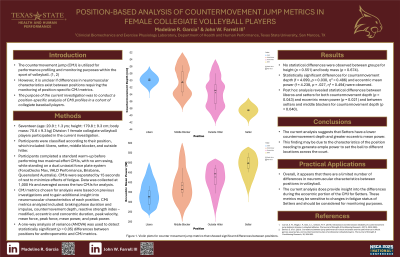
Purpose: The countermovement jump (CMJ) is utilized for performance profiling and monitoring purposes within the sport of volleyball. However, it is unclear if differences in neuromuscular characteristics exist between positions requiring the monitoring of position-specific CMJ metrics. The purpose of the current investigation was to perform a position-specific analysis of CMJ metrics in collegiate volleyball players. Methods: Seventeen participants were recruited from a collegiate female volleyball program to participate in the current investigation. Participants were classified according to their position, which included: libero, setter, middle blocker, and outside hitter. All participants completed a standard warm-up before performing two maximal effort CMJs, with no arm swing, while standing on a dual uniaxial force plate system (ForceDecks Max, VALD Performance, Brisbane, Queensland Australia). CMJs were separated by 15 seconds of rest to minimize effects of fatigue. Data was collected at 1,000 Hz and averaged across the two CMJs for analysis. Data was analyzed using the force plate system’s commercially available software ForceDecks (VALD Performance, Brisbane, Queensland Australia). CMJ metrics chosen for analysis were based on previous investigations and to gain additional insight into neuromuscular characteristics of each position. CMJ metrics analyzed included: braking phase duration and impulse, countermovement depth, reactive strength index – modified, eccentric and concentric duration, peak velocity, mean force, peak force, mean power, and peak power. A one-way analysis of variance (ANOVA) was used to detect statistically significant (p < 0.05) differences between positions for anthropometric and CMJ metrics. Results: No statistical differences were observed between groups for height (p = 0.551) and body mass (p = 0.674). However, statistically significant differences for countermovement depth (f = 4.099, p = 0.030, η2 = 0.486) and eccentric mean power (f = 4.238, p = .027, η2 = 0.494) were observed (Table 1). Post hoc analysis revealed statistical differences between liberos and setters for both countermovement depth (p = 0.043) and eccentric mean power (p = 0.021) and between setters and middle blockers for countermovement depth (p = 0.040). Conclusions: The current analysis suggests that Setters have a lower countermovement depth and greater eccentric mean power. This finding may be due to the characteristics of the position needing to generate ample power to set the ball to different locations across the court. Practical Applications: Overall, it appears that there are a limited number of differences in neuromuscular characteristics between positions in volleyball. However, the current analysis does provide insight into the differences during the eccentric portion of the CMJ for Setters. These metrics may be sensitive to changes in fatigue status of Setters and should be considered for monitoring purposes. Acknowledgements: None