Assistant Professor Southern Utah University Cedar city, Utah, United States
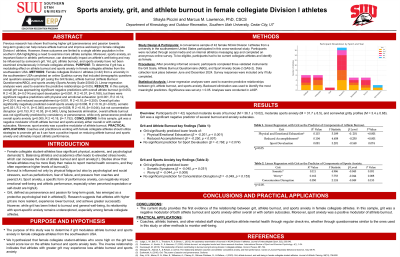
Purpose: To determine if grit has a modulating effect on athlete burnout and sports anxiety in female collegiate athletes from the southwestern USA. Methods: Female collegiate Division I athletes (n=42) from a university in the southwestern USA completed an online Qualtrics survey. The survey included demographic questions as well as questions assessing for grit (overall score and consistency and perseverance subscales) using the Short Grit Scale/Grit-S, athlete burnout (overall score and physical and emotional exhaustion, reduced accomplishment, and sport devaluation subscales) with the Athlete Burnout Questionnaire/ABQ, and sports anxiety (overall score and somatic, worry, and concentration disruption subscales) with the Sports Anxiety Scale-2/SAS-2. Linear regression analyses were used to examine the predictive relationships between grit, athlete burnout, and sports, p< 0.05. Results: In this sample, overall grit was approaching significant negative predictions with overall athlete burnout (p=0.053, R 2 =0.90, β=-0.014) and sport devaluation athlete burnout subscale (p=0.081, R 2 =0.07, β=-0.168), but there were significant negative predictions with physical and emotional exhaustion (p< 0.001, R 2 =0.12, β=-0.201) and reduced accomplishment (p< 0.001, R 2 =0.10, β=-0.250) athlete burnout subscales. Overall grit also significantly negatively predicted overall sports anxiety (p=0.008, R 2 =0.16, β=-0.023), somatic (p=0.031, R 2 =0.11, β=-0.045) and worry (p=0.008, R 2 =0.16, β=-0.044), but not concentration disruption (p=0.153, R 2 =0.05, β=-0.049) sports anxiety subscales. Using backwards elimination, overall athlete burnout was not significantly predicted by either consistency or perseverance grit subscales. Moreover, overall sports anxiety was only significantly negatively predicted by perseverance grit subscale (p=0.005, R 2 =0.18, β=-7.752).Conclusions: In this sample, grit was a negative modulator of both athlete burnout and sports anxiety either overall or with certain subscales. Moreover, sport anxiety was a positive modulator of athlete burnout. Practical Applications: Coaches and practitioners working with female collegiate athletes should utilize strategies to promote grit as it can have a positive impact on reducing athlete burnout and sports anxiety and ultimately impact athletic performance. Acknowledgements: None.