ASSOCIATE PROFESSOR OF HEALTH SCIENCES Furman University Greenville, South Carolina, United States
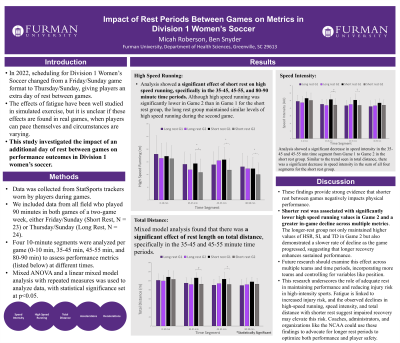
Purpose: This study investigated the impact of an additional day of rest between games on performance outcomes in Division 1 women’s soccer. Specifically, we examined whether shifting from a Friday/Sunday schedule to a Thursday/Sunday schedule improves player performance. Methods: Tracker data was analyzed from all conference games over four seasons for a Division I women’s soccer team. We included data from all players–excluding goalkeepers–who played 90 minutes in both games of a two-game week, either Friday/Sunday (shorter rest, N = 23) or Thursday/Sunday (longer rest, N = 24). Four 10-minute segments were analyzed per game (0-10 min, 35-45 min, 45-55 min, and 80-90 min) to assess performance at different times. Performance metrics included high-speed running (HSR), speed intensity (SI), total distance (TD), accelerations, and decelerations. A linear mixed model analysis and multivariate tests were used to analyze data, with statistical significance set at p < 0.050. Results: High speed running during Game 2 was significantly lower in the shorter rest group than in the longer rest group (mean difference = 31.808 meters, p = 0.040). Additionally, the decline in HSR over the course of Game 2 was significantly greater in the shorter-rest group compared to the longer-rest group (p = 0.041). The percent-change analysis between Game 1 and Game 2 revealed that longer rest was associated with increased values of high speed running, speed intensity, and total distance, as well as a reduced rate of decline across these metrics during Game 2. Specifically, in the longer-rest group, high speed running was 75% higher in Game 2 than Game 1 during the 45-55 min interval and 14.2% higher during the 80-90 min interval for the longer-rest group. In contrast, for the shorter-rest group, HSR was 15.4% and 20% lower in Game 2 than in Game 1 in the same respective intervals. Similarly, speed intensity during the 45-55 minute interval increased by 16.6% with longer rest but declined by 12.4% with shorter rest, and total distance in the 80-90 minute interval increased by 3.1% with longer rest but declined by 10.6% with shorter rest. Multivariate tests further supported significant interactions between rest period and high speed running (p = 0.017), speed intensity (p = 0.004), total distance (p = 0.007), and decelerations (p = 0.048) in the 45-55 min interval. Conclusions: These findings provide strong evidence that shorter rest between games negatively impacts physical performance, particularly high speed running, speed intensity, and total distance. Shorter rest was associated with significantly lower high speed running values in Game 2 and a greater in-game decline across multiple metrics, displaying the effects of accumulated fatigue. The longer-rest group not only maintained higher values of HSR, SI, and TD in Game 2 but also demonstrated a slower rate of decline as the game progressed, suggesting that longer recovery enhances sustained performance. Practical Applications: This research highlights the importance of adequate rest for maintaining optimal performance in high-demand sports. Coaches, administrators, and scheduling bodies such as the NCAA could use these findings to reconsider how game schedules are structured, potentially advocating for longer rest periods between games. Acknowledgements: None