Assistant Professor Murray State University Murray, Kentucky, United States
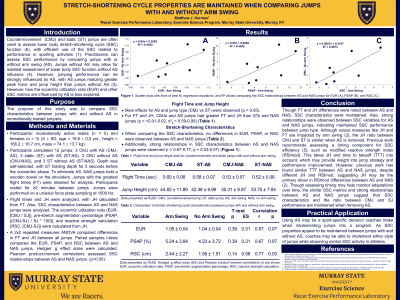
Purpose: The countermovement jump (CMJ) is used to assess lower body stretch-shortening cycle (SSC) performance through force-time analysis. Previous work has demonstrated that jumps with arm swing (AS) realize greater peak forces and jump height (JH) when compared to jumps without AS. Metrics like the eccentric utilization ratio (EUR) aim to measure one’s efficiency at using the SSC. Whether the EUR and other SSC metrics is influenced by AS is less explored. The purpose of this study was to compare SSC characteristics between jumps with and without AS in recreationally trained jumpers. Methods: Recreationally active males (n=5) and females (n=3) (X±SD, age=19.8±0.5 yrs., height=166.2±16.7 cm, mass=74.1±13.7 kg) completed 12 total jumps: 3 countermovement with AS (CMJ), 3 static with AS (ST), 3 countermovement without AS (CMJ-NAS), and 3 static without AS (ST-NAS). Participants were allowed to self-select a depth for all jumps, with ST jumps holding depth for 3 seconds before beginning the concentric phase. To eliminate AS, participants performed the CMJ-NAS and ST-NAS holding a wooden dowel on the shoulders. The jumps with the greatest flight times were retained for analysis. Participants rested at least 2 minutes between jumps. Jumps were performed on a uniaxial force plate sampling at 1000 Hz. Flight times (FT) and JH were analyzed, with FT used to calculate JH. Additionally, SSC characteristics between jumps with and without AS were analyzed. The eccentric utilization ratio (EUR, [CMJ / SJ]), pre-stretch augmentation percentage (PSAP, [(CMJ-SJ) / SJ * 100), and reactive strength calculation (RSC, [CMJ-SJ]) were calculated from JH for jumps with and without AS. A 2x2 repeated measures ANOVA compared the differences in FT and JH between all four jumps. Paired samples t-tests compared the EUR, PSAP, and RSC between jumps with and without AS. Hedges’ g effect sizes assessed magnitude of effect. Pearson product-moment correlations assessed the relationship of SSC characteristics between jumps with and without AS. (p< 0.05). Results: For FT and JH, main effects for jump type and AS indicated that jumps with a countermovement and jumps with AS had greater FT and JH than STs and no AS (p=< 0.01-0.02, η²p=0.59-0.95). When comparing the SSC characteristics between jumps with and without AS, no differences in EUR (1.05±0.04 vs 1.04±0.04, p=0.39, g=0.31), PSAP (5.24±3.84 vs 4.23±3.72, p=0.39, g=0.31) or RSC (0.02±0.02 vs 0.02±0.02, p=0.14, g=0.56) were found between jumps with and without AS, respectively. In addition, strong relationships in SSC characteristics between jumps with and without AS were found (r=0.67-0.77, p=0.03-0.07). Conclusions: Although differences in FT and JH between jumps with and without AS were noted, SSC properties were maintained when comparing jumps with and without AS. Though previous work has demonstrated differences in variables like peak force or time to takeoff, it appears that performance differences between countermovement and static jumps used to calculate the SSC metrics are similar between jumps with and without AS. Despite JH and FT differences, the SSC characteristics appear to be maintained. Practical Applications: Using AS may be a sport-specific decision coaches make when implementing jumps into a program. As SSC properties appear to be maintained between jumps with and without AS, coaches may be able to implement either style of jumps while realizing similar SSC activity in athletes. Acknowledgements: None

.jpg "Matthew J. Hermes, PhD (he/him/his) photo")