Assistant Professor Northwest Missouri State University Nebraska City, Nebraska, United States
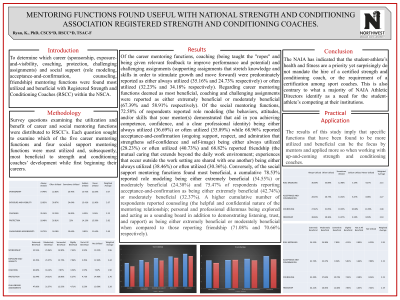
Purpose: To determine which career (sponsorship, exposure-and-visibility, coaching, protection, challenging assignments) and social support (role modeling, acceptance-and-confirmation, counseling, friendship) mentoring functions were found most utilized and beneficial with Registered Strength and Conditioning Coaches (RSCC) within the NSCA. Methods: Survey questions examining the utilization and benefit of career and social mentoring functions were distributed to RSCC’s. Each question sought to examine which of the five career mentoring functions and four social support mentoring functions were most utilized and, subsequently, most beneficial to strength and conditioning coaches’ development while first beginning their careers. Results: Of the career mentoring functions, coaching (being taught the "ropes" and being given relevant feedback to improve performance and potential) and challenging assignments (supporting assignments that stretch knowledge and skills in order to stimulate growth and move forward) were predominately reported as either always utilized (35.16% and 24.73% respectively) or often utilized (32.23% and 34.18% respectively). Regarding career mentoring functions deemed as most beneficial, coaching and challenging assignments were reported as either extremely beneficial or moderately beneficial (67.39% and 58.91% respectively). Of the social mentoring functions, 72.58% of respondents reported role modeling (the behaviors, attitudes, and/or skills that your mentor(s) demonstrated that aid in you achieving competence, confidence, and a clear professional identity) being either always utilized (36.69%) or often utilized (35.89%) while 68.96% reported acceptance-and-confirmation (ongoing support, respect, and admiration that strengthens self-confidence and self-image) being either always utilized (28.23%) or often utilized (40.73%) and 68.82% reported friendship (the mutual caring that extends beyond the daily work environment; experiences that occur outside the work setting are shared with one another) being either always utilized (38.46%) or often utilized (30.36%). Conversely, of the social support mentoring functions found most beneficial, a cumulative 78.53% reported role modeling being either extremely beneficial (54.55%) or moderately beneficial (24.38%) and 75.47% of respondents reporting acceptance-and-confirmation as being either extremely beneficial (42.74%) or moderately beneficial (32.37%). A higher cumulative number of respondents reported counseling (the helpful and confidential nature of the mentoring relationship; personal and professional dilemmas being explored and acting as a sounding board in addition to demonstrating listening, trust, and rapport) as being either extremely beneficial or moderately beneficial when compared to those reporting friendship (71.08% and 70.66% respectively). Conclusions: The findings highlight the critical role of coaching and challenging assignments in career mentoring and role modeling and acceptance-and-confirmation in social support mentoring. Mentors should prioritize these functions to support the development of aspiring strength and conditioning coaches effectively. Practical Applications: The results of this study imply that specific functions that have been found to be more utilized and beneficial can be the focus by mentors and applied more so when working with up-and-coming strength and conditioning coaches. Acknowledgements: None.